


My favorite everyday baby carrier is the Happy Baby Original, with the Mabe Monarch close behind. For a newborn, I would start with the Ergobaby Embrace or a soft wrap. And for the toddler who wants up, down, and back up again, I love having a Tushbaby. After trying more than 20 carriers with three very different babies, those are the options I would start with, depending on your stage.
My first baby was a summer baby, and I could not wait to wear her in a wrap. I had pictured all of those cozy newborn snuggles. What actually happened is that I wore her in it three or four times that entire first year, because between her body heat and mine in July, we were both miserable. She was also my most independent baby and did not love being contained, so my beautiful wrap I was so excited for just sat in a drawer until I figured out that a ring sling was what actually worked for us.
My second and third babies were born in winter, and they lived in a baby wrap for the first few months and structured carriers beyond that. Same carrier, completely different experience.
I grew to love baby wearing and started trying many different carriers: wraps, ring slings, soft structured carriers, hip seats, toddler carriers, and even carriers made for the pool. Below, I am sharing the ones I actually reach for, the ones I would skip, and the features I wish I had understood before I bought my first one. I have discount codes for most of the carriers on this list, and I note them as we go.
Below, I’ll explain the different types of baby carriers, how I choose between them, and the fit details I wish I had understood with my first. Your baby’s size, your comfort, and how you plan to use the carrier matter more than which one looks prettiest online.
Table of Contents
Prefer to watch? Check out my full baby carrier video:
Disclosure: This post contains affiliate links. You do not get charged anything extra, but my family receives a small commission when you shop through one of my links. We are so grateful for your support!
Everything I Recommend
Scroll for more →
The carrier I reach for most
Happy Baby OriginalLightweight linen, a hidden hood, and the widest fit range here. Beautiful without being impractical.

The look for less
Mabe MonarchCrossed back straps make it easy to put on alone, and it costs far less than carriers it resembles.

A wrap without the wrapping
Ergobaby EmbraceThe coziness of a wrap with three buckles instead of a learning curve. What I wish I had with my first.

The wrap that runs coolest
Tuck and Bundle WrapModal instead of stretchy cotton, so it is far less stifling. Packs into its own pocket.

The do-everything workhorse
Tula ExploreEvery carry position, three width settings, machine washable, and the one my husband actually wears.

For the baby who hates being contained
WildBird Ring SlingMore visibility, less fabric, and fast in and out. This is what lived in my diaper bag.

For the toddler who wants up again
TushbabyA hip seat with five pockets that takes the weight off your arms. My Disney line survival tool.

Gorgeous, with a trade-off
Sakura Bloom ScoutA cult following and beautiful linen. The rings are slower than buckles, so watch for sample sales.

Built for the pool
AquarooWetsuit-style material with real structure, and one of the few times I like outward facing.
The Different Types of Baby Carriers
These are the main carrier styles and stages I would consider. You do not need one of everything. Start with how old your baby is and whether you want longer hands-free stretches or quick ups and downs.
Newborn Carriers
While this isn’t necessarily a specific type, I think it deserves its own section because newborn-specific carriers were very confusing to me as a new mom, and I’m guessing others feel this way as well.
Many carriers list a minimum weight, but there is more to a newborn fit than the number on the scale. The panel and seat width need to fit your baby, the carrier must support their head and back, and their face must stay clear and visible. Use only the newborn setup or infant insert specified in that carrier’s instructions.
Some examples of newborn carriers include different types of wraps like the Wildbird Wrap and smaller, soft, structured carriers like the Ergo Embrace. These carriers also tend to have lower weight limits, which is why you’ll want to add another carrier to your registry as your baby grows (I will help more with this below).
Stretchy baby wraps
A stretchy wrap is typically one long piece of soft fabric that you wind around your body and tie. There are no buckles or hardware, just fabric. Check the weight limit for the exact wrap: the Tuck & Bundle below starts at 8 lbs, so I would not assume every fabric wrap fits a 7 lb newborn. I love wraps for those early snuggles because they fold down small enough to live in a diaper bag pocket.
Some downsides to stretchy wraps are the heat, the learning curve, and the extra time required to take them on and off. All that fabric, plus your body heat and your baby’s, adds up quickly in summer. The first few times you tie one, it feels like solving a puzzle while holding a very small person. Use the inward-facing position in the instructions for these stretchy wraps. As your baby gets heavier, you may prefer the support of a buckle carrier even before reaching the wrap’s maximum weight.
We have recently seen a few new baby wraps that have the same soft feel and look of a wrap, but without the learning curve. Check out my review of the Wildbird Aerial Wrap.
Ring Slings
A ring sling is a long piece of fabric threaded through two rings, worn over one shoulder. It uses far less material than a wrap, so it is cooler, and it gives your baby more visibility because there is only fabric on one side. That combination and my own experience with my first is why I recommend a ring sling so often to parents who tell me their baby hates being worn.
Depending on the sling, you can do a front, hip, or back carry. There are also several different sizes and materials to choose from. The trade-off is support. All of the weight sits on one shoulder, so it is not the one I grab for a long walk. I also found, as a first-time mom, the wrap felt tricky to get right with a newborn, but the more experience I have gotten with baby wearing, it has gotten easier with each baby.
Soft Structured Carriers
Soft structured carriers use buckles, padded straps, and a supportive waistband. They are the most versatile option and the most straightforward to learn. Many allow multiple positions: inward facing, outward facing, and back carrying.
If you are only going to buy one carrier, buy a soft structured carrier. It is the one that will still be useful two years from now.
Hip Seats
A hip seat is a structured seat on a padded waistband, designed for the toddler who wants up, down, and back up again every ninety seconds. It shifts your child’s weight off your arms and onto your hips. Most are not hands-free on their own, so you keep an arm around your child unless you add a hands-free attachment. This is one of my favorite carriers for Disney.
Toddler Carriers
Toddler carriers are soft-structured carriers with a taller panel and a wider seat for knee-to-knee support for a bigger kid. They are what you want when a hip seat won’t be enough support for a long day of walking.
We have also seen a recent trend with Toddler Slings. I compare all the most popular options in this cheat sheet!
Water Carriers
Water carriers are made from quick-drying, water-friendly materials for the pool, the splash pad, and the beach. This is the category most parents do not know exists. My husband found them years ago, and I thought it was silly, and then we had more kids, and it actually helped a lot in the pool.
Note: water carriers are not flotation devices, and your baby should never be submerged in one.
What Should You Look for When Choosing a Baby Carrier?

- Weight range and stage. Check the minimum and maximum weight. Some carriers start at 7 pounds with no insert, others require an infant insert, and toddler carriers usually start around 25 pounds.
- Your climate. We live in a hot climate, so mesh and lightweight linen make a difference. Baby wearing can be hot, but natural materials do help!
- Learning curve. Wraps and ring slings take practice. Buckle carriers are much more straightforward.
- Carry positions. Decide whether you need outward-facing or back carry. Inward facing is my preference for everyday wear, and back carry becomes essential once your toddler’s head starts blocking your view.
- Supported positioning. Look for an adjustable seat width that supports your baby’s thighs without forcing their legs apart. Check the fit and airway every time, using the instructions for your exact carrier.
- Quick in and out. If your child is in and out constantly, a ring sling or hip seat will serve you better than a structured carrier with five adjustment points.
- Who else is wearing it. If your partner will use it too, look for something that adjusts quickly between two very different body sizes, and a print you both like.
- Packability. A wrap or ring sling folds into a diaper bag pocket. A structured carrier does not as easily.
- Washability. Wraps and most cotton structured carriers are machine washable. Specialty fabrics are usually spot-clean only, so check before you buy.
- Budget and resale. Carriers hold their value well. Nearly every popular brand has an active buy, sell, and trade group, and many run sample sales.
How do you know a buckle carrier fits you?
Padded shoulder straps can feel very different once your baby is in the carrier. Adjust the waistband and straps so the load feels supported instead of hanging from your shoulders. A lumbar support pad can be helpful for some parents, but extra padding is not automatically more comfortable. I would check whether you can reach the buckles and tighten the adjustable straps without someone helping every time.
If two adults will share it, try the adjustment range on both of you. And if you cannot get a secure, comfortable fit for both the wearer and the baby, a certified babywearing educator or the manufacturer’s fit-check service can be more useful than buying another carrier at random.
Babywearing Safety: How to Check the Fit Every Time
No matter which carrier you choose, check the fit every single time you put it on. The easiest way to remember what you are looking for is T.I.C.K.S., a five-point check from the UK Sling Consortium that takes about ten seconds once you know it.

- Tight. Your baby should be snug against you with no loose or sagging fabric. A loose carrier lets your baby slump down, which can compromise their airway.
- In view at all times. You should be able to see your baby’s face with a glance down. Nothing should be covering their face, including the carrier fabric, a blanket, or a nursing cover.
- Close enough to kiss. Tip your head down. You should reach the top of your baby’s forehead without straining. If they have settled lower than that, tighten the carrier.
- Keep chin off chest. A curled-forward chin restricts the airway, and this is the one that matters most with newborns and in wraps.
- Supported back. Your baby’s back should hold its natural curve, with their knees higher than their bottom in the M position. This is the same positioning that supports healthy hips, and according to the International Hip Dysplasia Institute, babywearing with the hips in the spread-squat position supports healthy hip development.
Keep checking your baby while wearing them, not just when you first put the carrier on. The American Academy of Pediatrics advises keeping the face visible and the nose and mouth clear. Ask your pediatrician about carrier use if your baby was premature or has breathing concerns. Do not use a carrier that lets your baby slump with their chin pressed to their chest.
My Favorite Baby Carriers
| Carrier | Price | Weight Range | Positions | Shop |
|---|---|---|---|---|
| Happy Baby OriginalBest Overall | $169 | 7 to 45 lbs | Front inward, back | Shop |
| Tula ExploreBest for Dads and Outdoors | $219 | 7 to 45 lbs | Front inward, front outward, back | Shop |
| Mabe MonarchRunner-Up | $129 | 9 to 45 lbs | Front inward, front outward, back | Shop |
| Ergobaby EmbraceBest Newborn Carrier | $99 | 7 to 25 lbs | Newborn facing in, facing in, facing out | Shop |
| Tuck and Bundle WrapBest Wrap for Newborns | $78 | 8 to 35 lbs | Front inward | Shop |
| WildBird Ring SlingBest Ring Sling | $59+ | Newborn to 35 lbs | Front, hip, back | Shop |
| TushbabyBest Hip Seat | $75+ | Up to 45 lbs | Hip seat, front, side | Shop |
| Sakura Bloom ScoutBest Luxury | $340+ | 7 to 45 lbs | Front inward, back | Shop |
| AquarooBest Water Carrier | $175 | 12 to 30 lbs | Front inward, front outward | Shop |
Happy Baby Original: Best Overall


The Happy Baby Original is the carrier I wanted since my first baby and did not buy until my third, and I am a little annoyed at myself for waiting. It is beautiful, and unlike many other pretty carriers, it is also the most practical one I own.
Mine is linen, so it is lightweight and breathable with slightly less padding than most structured carriers, which is a real advantage in a hot climate. They do sell linen cotton blends if you are looking for one that is a little softer. There is a hood tucked into a hidden pocket that pulls out for sunny days or a sleeping baby, and disappears when you do not need it. It supports 7 to 45 pounds without the need for an infant insert, and the straps adjust across a wide range of body types, so my husband and I can easily share it.
I use it for inward-facing front carrying and for back carrying once my babies got older. This is what I grab when I am doing yard work with a toddler on my back. If you want outward-facing, Happy Baby makes the Revolution, which allows a forward-facing position after 6 months. I used their toddler carrier this summer in Europe with my 2.5 and 4-year-old and loved it.
Pros:
- Lightweight and breathable, especially in linen
- Hidden hood for sun and sleeping babies
- Fits a wide range of body types, easy to share between parents
- Folds down small enough for a diaper bag
- Beautiful without sacrificing function
Cons:
- Expensive at $169 (use my discount code to save), though it holds resale value better than almost anything on this list
- No outward-facing option on the Original, so look at the Revolution if that matters to you
- Linen needs more careful washing than cotton or mesh, which is worth knowing before the first blowout
Trying to decide between this and the Mabe (another one of my favs)? I compared them side by side in my Happy Baby vs. Mabe Monarch review.
Mabe Monarch: Runner-Up Soft Structured Carrier

The Mabe Monarch is the carrier I get the most questions about, mostly from people who have seen it on social media and want to know if it lives up to the hype. It does. A friend told me about it when I had my third baby, and it has been one of my favorites ever since.
It has the look of the much more expensive carriers at $129 (plus save $10 with my code), and the straps cross on your back, which makes it genuinely easy to put on by yourself. I was able to get a good ergonomic position with my baby, and it is comfortable and did not hurt my back. It works from 9 to 45 pounds and can be worn inward-facing, outward-facing, or on your back.
If you are looking to save, you can also find it slightly more affordable on Goodbuy Gear (try code STROLLER10)!
Pros:
- Much more affordable than carriers with a similar look
- Crossed back straps make it easy to put on alone
- Comfortable newborn positioning
- Three carry positions
Cons:
- Some parents have a hard time getting a good fit for newborns
- No sun shade, though the pop-up panel does work well for the first few months
I also compared it to the WildBird Aerial in my WildBird Aerial vs. Mabe Monarch post.
Ergobaby Embrace: Best Newborn Carrier

The Ergo Embrace (use my code StrollerM15 to save) is a soft-structured carrier designed specifically for newborns. It can be used up to 25 lbs, and parents love this carrier. It is so easy to use and is very comfortable for both parent and baby. I wish I had gotten this over my Solly Wrap with my first. I think it would have made a big difference.
Pros:
- Easy to Use
- Lots of colors
- Can be worn inward (from birth) or outward facing (6 months+)
- Machine washable
- Very soft, close newborn carry
Cons:
- You will likely need a second baby carrier
- No prints (floral, animal, etc.)
- Not made with natural materials like cotton and linen
Tuck & Bundle Wrap: Best Wrap for Newborns

I used a wrap for the newborn stage with my second 2 babies, and I loved it once I got over the learning curve. I have tried several wraps, and Tuck and Bundle was one of my favorites. It is made from modal, which is softer, and I felt a little cooler than other wraps.
It has a little pocket that the whole wrap tucks into, so it stores tiny in a diaper bag. It is machine washable, which matters in the newborn months. And it is inward-facing only, which is the only position you can use for the first six months anyway.
The learning curve is real. Watch the tutorial, practice with a stuffed animal on your kitchen counter, and give yourself a few tries before you decide it is not for you.
Pros:
- Modal is soft and thinner than cotton
- Packs into its own pocket
- Machine washable
- Snug, close newborn carry
Cons:
- Learning curve
- Still warm in summer, because a wrap is a lot of fabric
- One position only, and a short usable window
Watch my comparison of the Tuck & Bundle to the Solly Wrap here.
Tula Explore: Best for Dads and Outdoor Families

The Tula Explore is a workhorse. It is not the prettiest carrier on this list (but prettier than Ergobaby Omni in my opinion), and it is the one my husband has worn with our kids more than any other. If you are an outdoorsy family, or you want one carrier that will handle anything thrown at it, this is it.
I have the mesh version because of our climate, and it makes a noticeable difference on a hot day. It works from 7 to 45 pounds with no infant insert, and the body panel adjusts to three width settings so you get good support from a newborn all the way up. There is a hood, a padded neck support panel that pops up and down, and inward-facing, outward-facing, and back carrying positions. I could carry my three-year-old in it comfortably.
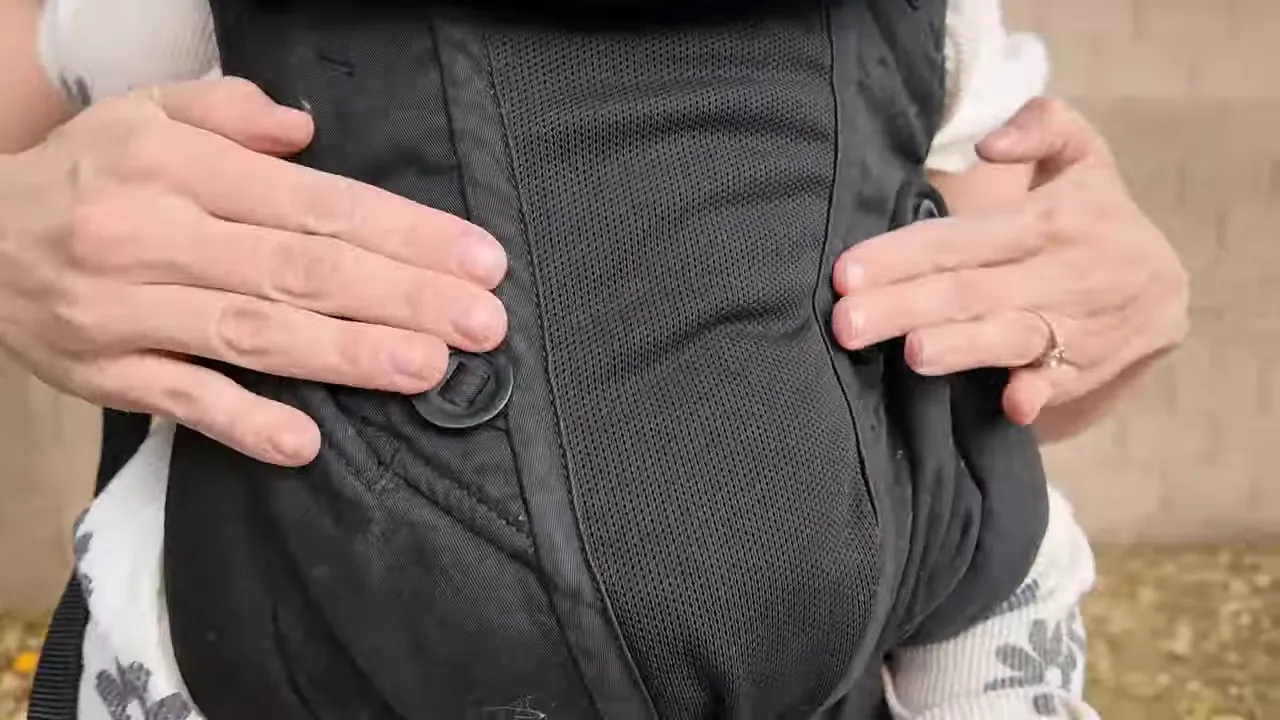
For years, this was my go-to for back-carrying. It is easy to put on, the cotton canvas is machine washable, and it comes in enough prints that you will find one you both like.
Pros:
- Three useful carry positions: front inward, front outward, and back carry
- Mesh version is cooler in hot weather
- Multiple width settings for proper positioning at every stage
- Machine washable
- Easy for two parents to share
Cons:
- The most expensive structured carrier here at $219, though my code brings it down
- Bulkier than the linen carriers, so it does not disappear into a diaper bag the way the Happy Baby and Mabe do
- Not the prettiest option, though the mesh and the print selection have grown on me
Prefer to watch? Here’s my full Tula Explore review:
WildBird Ring Sling: Best Ring Sling

The WildBird Ring Sling is the carrier that saved me with my first baby. She did not want to be contained, and the ring sling gave her more visibility and more freedom while still keeping her close. It is not the easiest to use in the newborn days, but from 3+ months it became my favorite.
I have the modal version, which is softer and has more give. The linen versions offer a bit more structure and are recommended for a heavier baby. Once I stopped using the wrap, this is what lived in my diaper bag, because it is so much smaller than a structured carrier and so fast to get a baby in and out of. It is what I take to church and to pediatrician appointments where she is going to be up and down constantly.
I still use it with my toddlers for a quick hip carry. The biggest downside is that all the weight sits on one shoulder, so this isn’t the carrier for a two-hour walk.
Pros:
- Cooler than a wrap, with far less fabric
- Packs down very small
- Fast to get baby in and out
- Works for hip carries well into toddlerhood
- One of the most affordable carriers on this list
Cons:
- All of the weight sits on one shoulder, so this is a quick-trip carrier and not a long-walk carrier
- Threading the rings takes practice, and the first few tries will feel wrong
Tushbaby: Best Hip Seat

I bought my Tushbaby because of my second daughter, my velcro baby, who always wanted to be carried. My arms needed help, and the structured carriers were not working for how often she wanted to be carried up and then immediately back down.
It is a hip seat on a padded, supportive waistband, and it takes your child’s weight off your arms and onto your hips. There are five pockets and a tuck-away bottle holder, so for a quick errand it replaces a diaper bag entirely. It works up to 45 pounds and about 36 months.
Tushbaby’s newborn use is as feeding support, with your baby held securely. Upright hip-seat carrying and the separate hands-free attachment have their own age, weight, and head-control requirements. For me, its biggest strength is still the toddler stage: standing in a Disney line and picking up a tired child over and over is exactly where I appreciate that hip seat.
Pros:
- Fastest ups and downs of anything on this list
- Storage is good enough to skip the diaper bag on short outings
- Takes real weight off your arms and back
- Folds up for a stroller basket or carry-on
Cons:
- Not hands-free on its own, so you keep an arm around your child unless you add the Snug attachment
- A little bulky
- The structured seat can feel warm against you in summer
For a closer look at fit, storage, and everyday use, see my honest Tushbaby review.
Sakura Bloom Scout: Best Luxury Carrier

The Sakura Bloom Scout is stunning, and there is a genuine cult following behind it. Mine came from one of their sample sales, which is how I would recommend buying one, because the price ranges quite a bit depending on the fabric and style.
My baby was always very comfortable in it, and I do think it is a good carrier. The reason I reach for the Happy Baby more often comes down to the rings. Adjusting rings on the shoulders and hips is slower than clicking a buckle, and even when I tucked the tail in, I kept catching it on doorways. If you love the look and you do not mind the extra step, it is beautiful. If you want to get out the door in fifteen seconds, buy the buckles.
Pros:
- Beautiful fabrics and a devoted following
- Comfortable for baby
- Strong resale value, plus sample sales and buy, sell, and trade groups
Cons:
- By far the most expensive carrier here at $340 and up, though sample sales and resale groups bring it within reach if you are patient
- Rings are slower to adjust than buckles, which matters more than it sounds when you are trying to leave the house
- The long tail catches on doorways, even when you tuck it
Aquaroo: Best Baby Carriers for the Pool and Beach

The Aquaroo is made from a wetsuit-style scuba material, and it has more structure than most water carriers. The pool is one of the very few times I actually want my baby facing out, because there is so much for them to look at, and this carrier does that well.
It is an investment for something you use at the pool, and I did not love it during the 3 to 5 month stage. It came into its own once my baby was older and could face out and take advantage of the extra structure. It works from 12 to 30 pounds.
Pros:
- Quality material built specifically for water
- Outward facing works beautifully at the pool
- More structure than most water carriers
Cons:
- $175 for a carrier you use at the pool, so it earns its keep only if you swim often
- Not my favorite for the 3 to 5 month stage; it comes into its own once they can face out
- Narrow 12 to 30 pound range, which is a shorter window than it sounds
For more water options across different budgets, see my full guide to the best waterproof baby carriers.
Best Baby Carrier for Wearing While Pregnant: Onbuhimo Carriers
An onbuhimo is a back carrier with no waistband, designed for babies around 6 months and up who have solid head and neck control. Both Happy Baby and Sakura Bloom make one, and I was confused about the point of them for a long time.
Some parents love them once you build up the shoulder strength, and if you end up expecting again while your first is still needing a carrier, an onbuhimo lets you do a high-back carry with nothing across your belly. It is also a good option for anyone recovering postpartum or who simply dislikes a waistband.
One thing to keep in mind: because there is no waistband, all of the weight goes to your shoulders. It did tend to hurt my back, and you really do have to build up to it.
Other Carriers Worth Considering
These did not make my top picks, but they are worth knowing about depending on your budget and what you are looking for.
WildBird Aerial
The Aerial is WildBird’s buckle carrier; it is a very popular, pretty structured carrier. It is European linen with a mesh lining and can be used for inward-facing on the front and on your back, with no outward-facing option.
WildBird recommends it for babies from around 2 months rather than from birth, and points newborn parents to their Aerial Buckle Wrap instead, which I really like (review here). If you are weighing it against the Mabe, I broke them down side by side in my WildBird Aerial vs. Mabe Monarch comparison. You can shop it here and save 10% sitewide with my link.
Boba Wrap
The Boba Wrap is the budget wrap option, starting around $34. The stretchy cotton is firmer and more structured than modal, so you can get a very snug wrap, but the fabric is thicker and a little warmer. If you are not sure whether wrapping is for you, this is the one to try first, and it is very easy to find secondhand. So many parents buy a wrap with great intentions, use it a handful of times, and pass it along. You can find it on Amazon here.
Best Toddler Carriers

Toddlerhood is where babywearing changes. You are not wearing them all day anymore, you are carrying them when their legs give out at the zoo, in an airport, or three-quarters of the way up a trail. The Tushbaby above is my pick for constant ups and downs, but once your child is too heavy for a hip seat to feel comfortable over a long stretch, you want a toddler carrier with a taller panel and a wider seat.
A few worth knowing about:
- Tula Toddler. This is the step up from a hip seat, made for kids from about 25 to 60 pounds and usable up to around 6 years old. You can wear it on the front or the back, and I strongly prefer the back. Once they are tall enough, their head blocks your view in a front carry, and you end up walking sideways through your own house. A supportive back carry is what makes travel days and long walks manageable again. It comes in mesh, cotton, and linen, and it runs about $179. Shop it here and save 15% with code STROLLERMOM15.
- Mabe Monarch Toddler Sling. This one has been all over my social media, and I gave it a try because I am in the thick of toddler parenting and will try almost anything that makes life easier. It is a padded strap over one shoulder with a roomy fabric seat on the opposite hip, and I had it out of the box and on within about a minute. It is light, packs smaller than a hip seat, machine washable, and my toddler is happy to sit in it for ages. My husband wears this one without complaint. Two honest caveats: it is not hands-free, so you keep a hand on your toddler, and the strap does not shorten enough for petite parents. It is $89 for 16 to 45 pounds, from about 9 months. I wrote a full Mabe Monarch Toddler Sling review if you want the details, and code STROLLER10 saves 10% sitewide.
Which Baby Carrier Is Right for You?
There is no perfect baby carrier, only the right one for your stage, your body, and the way your family actually lives. Most parents I talk to end up with two: one for the newborn months and one that grows with them.
If you are only buying one, buy a soft structured carrier. The Happy Baby Original or Mabe Monarch are two of my favorites, and the Tula Explore can be a more versatile option.
For the newborn days, I would look at the Ergo Embrace. If your baby fights being contained, or you need something that lives in your diaper bag, get a ring sling. And once you are in the fun up-and-down stage, a Tushbaby will save your arms.
One last thing worth saying: your child gets a vote. My velcro baby loved being worn from day one. My oldest tolerated it. My third loves the snuggles. It can take a few tries and a lot of repetition before your baby is happy in a carrier, and that is normal.
If this post helped you narrow things down, please consider shopping through my links and using my discount codes. It supports my work at no extra cost to you, and I am so grateful you are here.
Baby Carrier FAQs
What is the best baby carrier overall?
The Happy Baby Original is the everyday carrier I reach for most, and the Mabe Monarch is a close runner-up. For a newborn, I would also consider the Ergobaby Embrace. The best fit depends on your baby’s stage, your body, and whether you want quick ups or longer carries.
Are baby carriers safe for newborn hips?
Choose a carrier approved for your baby’s size and stage, then follow its positioning instructions. The seat should support the thighs and allow a comfortable bent-knee position. Hip positioning is only part of the fit: head support and a clear airway matter too. Ask your pediatrician for guidance if your baby has a hip condition or other medical needs.
Which baby carriers are safe for newborns?
Some wraps, ring slings, and buckle carriers are designed for newborns, but not every model fits from birth. Check the minimum weight, any height or developmental requirements, and whether an approved infant insert is required. I like newborn-specific options such as the Ergobaby Embrace because getting a good fit can be simpler.
Why does my baby hate baby carriers?
Your baby has an opinion. First, make sure you have it on correctly! My second was my velcro baby who wanted to be worn constantly. My oldest was independent and tolerated it, but it was never her favorite. It can take a few tries to find the carrier your baby actually likes. Check that the carrier is not too hot and not too tight, then keep practicing. Like a swing or a car seat, it often just takes repetition and consistency before your baby is genuinely happy in it.
Should baby face inward or outward in a carrier?
I prefer inward facing for everyday wearing. Outward facing is only an option when your specific carrier allows it and your baby meets its weight and developmental requirements, including strong head and neck control. Follow the manual’s position and time limits rather than using age alone.
Are ring slings good for toddlers?
Yes. A ring sling is great for a toddler hip carry, and it is much faster than buckling into a structured carrier for a two-minute up. It also packs down far smaller, so it is easy to keep in a diaper bag for those moments. I compare all the best toddler slings here.


